
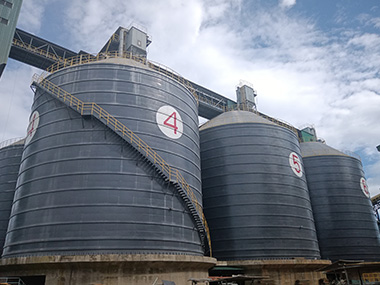

Steel Silo Tax Depreciation Strategies: What Plant Owners Actually Need to Know
Steel silos aren't a single asset on your books — they're a dozen components with different lifespans, and treating them as one lump-sum depreciation line is costing you money. The right strategy depends on how you classify the shell, the roof, the aeration system, the dust collector, and the foundation under local tax codes. I've seen plants in Indonesia, Brazil, and South Africa recover 15-30% more in early-year deductions simply by splitting their silo asset correctly.
Why Component-Based Depreciation Beats Straight-Line for Steel Silos
The Problem with Lumping Everything Together
Most accountants I've worked with want to book a cement silo as one fixed asset — say, 25-year straight-line depreciation on the total installed cost. That feels clean. It's also wrong, and it's leaving real money on the table.
Here's why: a 5,000-tonne cement silo isn't one thing. The steel shell might last 30-40 years with proper maintenance. The galvanizing or paint system? 12-18 years before major recoating. The aeration pads and blowers? 8-12 years. The dust collector filter media? 2-4 years. The load cells and level instruments? 10-15 years. The foundation? 50+ years. When you depreciate all of that at the same 4% annual rate, you're over-depreciating the short-life components and under-depreciating what actually wears out fast.
In the US, the IRS recognizes this through MACRS (Modified Accelerated Cost Recovery System), which lets you assign different recovery periods to different asset classes. A steel silo shell falls under 20-year property if it's manufacturing-related, but the dust collection system might qualify as 7-year property. That difference in Year 1-3 cash flow is substantial — we're talking about accelerating $80,000-$150,000 in deductions on a mid-size silo project.
The same principle applies under IFRS (IAS 16) and most local GAAP frameworks. If components have "significantly different useful lives," they must be depreciated separately. Most tax authorities actually require it — they just don't enforce it unless you're audited.
How to Split the Silo Asset: A Practical Breakdown
After commissioning dozens of projects across 30+ countries, here's the component split I recommend to clients' finance teams. This isn't gospel — your local tax code and auditor may push back on specific categories — but it's defensible and technically grounded:
- Steel shell and structural supports: 25-30 years. This is the welded or bolted cylinder, stiffeners, columns, and ring beams. If it's hot-dip galvanized (per ASTM A123), the corrosion protection alone justifies the upper end of that range.
- Roof structure and cladding: 20-25 years. The roof takes weather exposure the shell doesn't. Standing seam roofs outlast corrugated by a decade in my experience.
- Internal aeration system: 10-15 years. Aeration pads, air slides, and ductwork suffer abrasion from cement, fly ash, or coal dust. The blowers themselves — 8-12 years depending on duty cycle.
- Dust collection system: 10-15 years for the housing, 2-4 years for filter bags. This is where the biggest acceleration opportunity lives.
- Level instrumentation and load cells: 10-15 years. Capacitance probes, radar level sensors, and strain-gauge load cells drift over time. Calibration intervals tell you when they're aging out.
- Discharge valves, feeders, and conveyors: 12-20 years depending on material abrasiveness. Coal is brutal on rotary valves — I've seen 10mm-thick wear plates gone in 14 months.
- Foundation and civil works: 40-50 years. Reinforced concrete mat or pile foundation per ACI 318 or Eurocode 2. This is real property, not personal property, and the classification matters.
- Electrical and control systems: 10-15 years. PLCs, VFDs, and wiring. Technology obsolescence often kills these before mechanical wear does.
The key is documenting the split with engineering evidence. A structural design report that assigns expected service lives to each component gives your auditor something concrete to file. I've written these reports myself — 2-3 pages of technical justification, signed off by our engineering department.
Local Tax Code Variations That Change the Math
United States: MACRS and Bonus Depreciation
Under current US tax law, if your silo qualifies as manufacturing or processing equipment, you can use MACRS 7-year or 20-year recovery periods depending on the asset class. The critical distinction is whether the silo is classified as "manufacturing property" (7-year) or "nonresidential real property" (39-year straight-line). A silo that feeds a cement mill directly into the production line? Manufacturing. A silo at a transload terminal that just stores product before trucking? That's the gray zone.
Bonus depreciation under Section 168(k) lets you deduct 60% of the qualifying asset cost in Year 1 (for property placed in service in 2024, phasing down from 80% in 2023). For a $1.2 million silo project, that's $720,000 in Year 1 deductions — if you've classified the components correctly. Miss the classification and you're spreading that over 39 years at $30,769/year.
I had a client in Texas who'd been depreciating their entire silo farm as 39-year property for six years. We reclassified the dust collectors, aeration systems, and instrumentation as 7-year property, filed a Form 3115 (Change in Accounting Method), and captured $340,000 in catch-up deductions in a single year. Their CPA had never heard of component depreciation for silos.
China: Accelerated Depreciation for Environmental and Safety Equipment
Under Chinese tax law (Enterprise Income Tax Law, Article 11 and related regulations), fixed assets can generally be depreciated on a straight-line basis with minimum statutory lives: 20 years for structures, 10 years for machinery, 5 years for electronic equipment. But there's a provision many plant owners miss: equipment designated for environmental protection, energy conservation, and safe production qualifies for accelerated depreciation — either shortened lives (60% of statutory minimum) or accelerated methods (double-declining balance or sum-of-years'-digits).
A dust collection system on a cement silo clearly qualifies as environmental protection equipment under the Catalogue of Enterprise Income Tax Preferentialities for Environmental Protection and Energy-Saving Water Conservation Equipment. That means a dust collector with a statutory 10-year life can be depreciated over 6 years. The silo shell itself doesn't qualify — it's a structure — but the dust collector, the explosion venting system (EN 14491 compliant), and the temperature monitoring system all can.
Under GB 50009 (Load Code for Building Structures), silo shells are designed as industrial structures with a 50-year design reference period. That doesn't mean you depreciate them over 50 years — the statutory minimum for steel structures in China is 20 years — but it gives you engineering justification if you need to argue for a longer life during an audit.
European Union: National Variations Under IFRS
IFRS requires component depreciation under IAS 16.43-47, but the actual tax treatment varies wildly by member state. Germany allows declining-balance depreciation at 3x the straight-line rate for movable assets. France has specific regimes for "industrial equipment" that permit 10-15 year lives on silo structures that would be 25+ years elsewhere. The UK's Annual Investment Allowance lets you deduct the full cost of qualifying plant and machinery up to £1 million in the year of purchase.
The practical takeaway: if you're building a silo in multiple jurisdictions, don't assume the depreciation strategy transfers. A component split that works in Düsseldorf might get rejected in Düsseldorf's tax office if you can't produce a German-language engineering report referencing DIN EN 1993-4-1 (Eurocode 3: Design of steel structures — Silos). I've seen exactly this happen on a project in Poland where the client's UK-prepared depreciation schedule was rejected because it didn't reference Polish national annexes to Eurocode.
Common Mistakes That Trigger Audits (And How to Avoid Them)
Mistake #1: Ignoring the Foundation Classification
The foundation is real property. The silo shell is personal property (in most jurisdictions). If you depreciate them together, you're either over-depreciating the foundation or under-depreciating the shell. Either way, an auditor will flag it.
I was on a project in Vietnam where the client had booked a $400,000 pile foundation as part of a 15-year silo asset. The tax authority reclassified it as 40-year real property, disallowed $180,000 in deductions over three years, and assessed penalties. The fix was simple in retrospect: separate the civil works contract from the silo supply contract, invoice them separately, and book them as separate assets. We now do this as standard practice on every EPC project.
Mistake #2: Not Tracking Component Replacements
When you replace a dust collector baghouse after 4 years, that's a new asset — not a repair to the old one. If you expense it as maintenance, you're fine. If you capitalize it and add it to the original silo asset, you've just inflated the book value of an asset that's already partially depreciated. Either way, you need to record the disposal of the old component.
Most plant accounting systems I've seen don't track silo sub-components at this level of detail. They should. A simple asset register with sub-asset codes for shell, roof, aeration, dust collection, instrumentation, and electrical takes an afternoon to set up and saves thousands in audit defense.
Mistake #3: Assuming Salvage Value Is Zero
Steel has scrap value. At current rates, a 5,000-tonne cement silo contains roughly 80-120 tonnes of structural steel. At $300-500/tonne scrap value, that's $24,000-$60,000 in salvage value you need to account for. It's not huge, but it's a number that should be in your depreciation calculation. More importantly, the galvanized coating adds value — galvanized steel scrap commands a premium because it feeds directly back into galvanizing kettles.
For tax purposes, salvage value is often ignored in jurisdictions that allow it (the US MACRS system assumes zero salvage). But under IFRS and many local GAAP frameworks, you must estimate residual value. Even a conservative 5-10% of shell cost affects the annual depreciation charge over a 25-year life.
Case Study: Component Depreciation on a 10,000-Tonne Clinker Silo in Saudi Arabia
A cement plant in Riyadh commissioned a 10,000-tonne clinker silo in 2022. Total installed cost: $2.8 million, including $340,000 for civil works, $1.6 million for the steel structure and internals, $420,000 for the dust collection and aeration system, $280,000 for mechanical equipment (feeders, valves, conveyors), and $160,000 for electrical and instrumentation.
The plant's finance team initially booked the entire $2.8 million as a single asset with 20-year straight-line depreciation — $140,000/year. After we provided a component breakdown with engineering justification referencing Saudi Income Tax Law Article 17 and SOCPA (Saudi Organization for Certified Public Accountants) guidance, they reclassified as follows:
- Civil works (foundation, platforms, stairways): $340,000 at 25-year life = $13,600/year
- Steel shell and roof: $1,100,000 at 25-year life = $44,000/year
- Internals (aeration, air slides): $500,000 at 15-year life = $33,333/year
- Dust collection system: $420,000 at 10-year life = $42,000/year
- Mechanical equipment: $280,000 at 15-year life = $18,667/year
- Electrical and instrumentation: $160,000 at 10-year life = $16,000/year
Total annual depreciation under the component approach: $167,600/year. That's $27,600/year more than the straight-line approach — a 19.7% increase in annual deductions. Over the first five years, the plant captured an additional $138,000 in tax savings at the 20% Saudi corporate tax rate. Not life-changing money, but it paid for the engineering report three times over.
The bigger win was in Year 6, when the dust collector filter bags and aeration pads needed replacement — $85,000 in costs. Because those components had been fully depreciated by Year 5 (under the 10-year and 15-year schedules), the replacement was booked as a new asset with its own depreciation schedule. Under the original single-asset approach, the replacement would have been capitalized into a 20-year asset that was already 30% depreciated, creating a messy partial-disposal calculation.
FAQ
Q: Can I depreciate a steel silo faster than its physical life?
Tax depreciation lives and physical lives are different things. Tax codes set recovery periods based on policy, not engineering. In the US, a silo shell might be 20-year MACRS property even though it'll physically last 35 years. In China, accelerated depreciation provisions let you write off environmental equipment in 6 years regardless of its actual service life. The key constraint is documentation — you need to show the tax authority that your classification aligns with their rules, not just your engineering judgment.
Q: What about bolted vs. welded silos — does the construction method affect depreciation?
Not directly for tax purposes, but it matters for component identification. Bolted silos (like the ones we build for projects where on-site welding is impractical or too expensive) have more clearly separable components — the shell panels, bolts, seals, and stiffeners can theoretically be disassembled and replaced individually. This actually strengthens your case for component depreciation because the physical separability mirrors the accounting separation. Welded silos are monolithic, which makes the argument harder but not impossible. The aeration system, dust collector, and instrumentation are still separable regardless of how the shell was built.
Q: How do I handle depreciation when a silo is relocated or repurposed?
This is where it gets complicated. If you move a silo from one plant to another, you're dealing with a partial disposal and reacquisition. The book value at the time of removal needs to be written off, and the reinstallation cost becomes a new depreciable asset. I've seen this go wrong when a company in South Africa dismantled a 3,000-tonne fly ash silo, moved it 200 km, and reinstalled it — but kept the original depreciation schedule running as if nothing had changed. The tax authority disallowed two years of deductions because the asset had technically been disposed of. If you're relocating a silo, talk to your tax advisor before the first bolt comes loose.
Get Your Silo Asset Classification Right From Day One
Every Manxing EPC project includes a component-level asset breakdown with engineering-justified service life estimates — structured to support component depreciation under your local tax code. We've prepared these reports for projects in 30+ countries, referencing MACRS, IFRS, GB standards, and local tax regulations.
Send your project scope to manxingstorage.com and ask for the depreciation support package. It's included in our EPC proposal at no extra cost, and it'll pay for itself in Year 1 tax savings.