How can project owners reduce steel silo procurement costs without compromising structural integrity? Through strategic design standardization, material optimization, and EPC procurement models that eliminate intermediary margins. What drives the largest cost variations? Foundation design and ancillary systems typically account for 30–40% of total project cost, making them the highest-impact areas for optimization. This article provides actionable strategies for capital expenditure reduction across the full procurement lifecycle.
1. Design Standardization and Capacity Planning
Figure 1Figure 2Figure 3
1.1 Diameter-to-Height Ratio Optimization
The diameter-to-height (D/H) ratio directly influences steel plate consumption, foundation loading, and wind resistance requirements. For capacities between 5,000 and 20,000 metric tons, an optimal D/H ratio between 0.45 and 0.65 minimizes steel weight per unit of stored volume. Deviating from this range increases wall thickness requirements due to hoop stress redistribution and buckling considerations under external pressure.
Wall thickness typically follows a stepped configuration rather than uniform thickness. A 10,000-ton cement silo with an 18-meter diameter may use 6 mm plates at the top tier, 8 mm at the mid-tier, and 10 mm at the bottom tier, reducing total steel weight by 12–18% compared to uniform-thickness designs. This stepped approach follows the linear decrease in internal pressure from bottom to top and can save 25–40 tons of steel per silo.
1.2 Modular Capacity Planning
Standardizing silo dimensions across a multi-silo project reduces fabrication costs significantly. When multiple silos share identical diameter specifications, manufacturers optimize nesting patterns for steel plate cutting, reducing material waste from typical 8–12% down to 4–6%. For a five-silo grain storage complex, modular planning saves $80,000–$150,000 in raw material costs alone.
Additionally, standardized diameters allow reuse of forming molds, jigs, and rolling setups during fabrication. This reduces changeover time by 30–40% and lowers labor hours per silo unit by approximately 15%.
2. Material Selection and Corrosion Protection
2.1 Steel Grade Selection Strategy
Selecting appropriate steel grades for specific silo components avoids unnecessary over-specification. Q235B carbon structural steel suffices for most wall panels and roof structures in non-corrosive environments, while Q345B high-strength low-alloy steel is reserved for high-stress zones such as the bottom ring beam and discharge cone junctions. Substituting Q345B for Q235B in critical sections increases yield strength by approximately 47% while adding only 8–12% to material cost.
For stored materials with moisture content above 12% or corrosive properties (such as fly ash or chemical powders), hot-dip galvanized steel with a zinc coating of 275 g/m² provides 20–30 years of corrosion protection without painting maintenance. The galvanizing premium of approximately 25–35% over bare steel is offset by eliminating repainting cycles every 5–7 years.
2.2 Cladding and Insulation Optimization
Corrugated steel cladding profiles (typically 0.5–0.7 mm thickness with trapezoidal profiles) provide structural stiffness that reduces or eliminates the need for secondary purlins. Selecting a higher-profile trapezoidal section (e.g., YX35-126-756) allows purlin spacing to increase from 1.5 m to 2.0 m, reducing purlin steel weight by 25–30%. For temperature-sensitive storage (seed grain, food-grade materials), polyurethane sandwich panels with 50–100 mm core thickness provide thermal insulation values of R-3.5 to R-7.0, maintaining internal temperature variation within ±3°C annually.
3. Foundation and Structural Optimization
3.1 Foundation Type Selection
Foundation costs represent 15–25% of total silo project expenditure and offer significant optimization potential. Ring-beam foundations suit most soil conditions with bearing capacity above 120 kPa, requiring approximately 40–60% less concrete than full-slab foundations. For a 15,000-ton silo on medium-density soil, a ring-beam foundation typically requires 180–250 m³ of concrete versus 400–550 m³ for a full raft foundation.
Pile foundations become economically necessary when bearing capacity falls below 80 kPa or when settlement sensitivity is high. Optimizing pile length through geotechnical investigation—rather than applying uniform safety factors—can reduce pile costs by 15–20%. A detailed soil boring program costing $5,000–$15,000 frequently yields foundation savings of $50,000–$200,000 on large-diameter silos.
3.2 Discharge System Design Impact
Fluidized discharge systems reduce residual material after emptying from 3–5% to below 1%, directly improving storage efficiency. However, the compressed air supply, aeration pads, and control systems add $30,000–$80,000 per silo. For materials with poor flowability (moisture content >15%, high fines content), this investment pays back within 18–24 months through reduced material loss and decreased manual cleaning labor.
Mechanical screw discharge systems offer lower capital cost ($15,000–$40,000) but higher residual rates. The optimal choice depends on material properties, discharge frequency, and labor cost in the project location.
4. EPC Procurement Models vs. Traditional Procurement
4.1 Single-Point Responsibility Benefits
Traditional split procurement (separate contracts for steel supply, fabrication, erection, and commissioning) introduces interface risks that typically generate 8–15% cost overruns through coordination gaps, schedule delays, and warranty disputes. An EPC (Engineering, Procurement, Construction) model consolidates responsibility under one contractor, eliminating these interfaces.
EPC contractors with in-house fabrication facilities achieve steel procurement at mill-direct pricing, bypassing trading company markups of 10–20%. For a project requiring 2,000 tons of steel, this translates to savings of $200,000–$500,000 depending on market conditions.
4.2 Procurement Timing and Market Conditions
Steel plate prices fluctuate 15–25% annually based on iron ore costs, energy prices, and regional supply-demand dynamics. Strategic procurement timing—placing orders during price troughs identified through 12-month moving average analysis—reduces raw material costs by 8–12%. EPC contractors with established mill relationships can lock prices 60–90 days before delivery, providing cost certainty that owner-managed procurement rarely achieves.
5. Ancillary Systems Cost Management
5.1 Conveying and Material Handling
Bucket elevators with capacities of 100–500 t/h represent $25,000–$120,000 per unit depending on height and capacity. Optimizing silo layout to minimize conveyor runs and elevator heights reduces both equipment and structural support costs. A well-planned radial conveyor arrangement serving four silos from a central receiving point reduces total conveying equipment cost by 20–30% compared to individual conveyor lines to each silo.
5.2 Dust Collection and Safety Systems
Bin vent dust filters sized for peak aeration and filling rates typically cost $3,000–$15,000 per silo. Over-specifying filter area increases both capital cost and ongoing energy consumption from fan operation. Proper sizing based on actual air displacement volume during filling (typically 1.2–1.5 times the material inflow rate) optimizes both initial cost and operating expense.
Pressure/vacuum relief valves, level indicators, and temperature monitoring systems add $8,000–$25,000 per silo. Selecting radar-level sensors ($1,500–$3,500) over more expensive nuclear gauges ($8,000–$15,000) provides equivalent accuracy for most granular materials while reducing regulatory compliance requirements.
6. Lifecycle Cost Considerations
6.1 Maintenance Cost Reduction Through Design
Design decisions made during procurement directly impact 20–30 year maintenance expenditure. Hot-dip galvanized bolted construction eliminates field welding and reduces maintenance painting from every 5–7 years to once every 15–20 years. Over a 25-year service life, this reduces cumulative maintenance costs by 40–60% compared to painted welded construction.
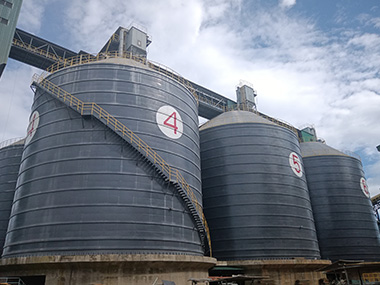
Access systems including external spiral stairways, roof platforms, and manholes with safety railings add $10,000–$30,000 during construction but reduce inspection and maintenance labor costs by enabling safe access without scaffolding rental or crane-assisted access.
6.2 Energy Efficiency in Aeration and Ventilation
Low-pressure aeration systems operating at 0.5–1.0 bar consume 30–50% less electrical energy than high-pressure systems (2–4 bar) for equivalent material fluidization performance. For a 10,000-ton grain silo with continuous aeration, this difference represents annual energy savings of $2,000–$5,000, accumulating to $50,000–$125,000 over a 25-year operational