
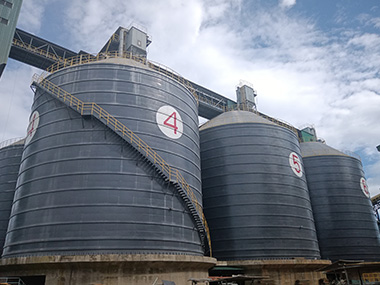

Steel Silo Asset Management Economics: The Numbers Nobody Shows You Before the Purchase Order
What does a steel silo actually cost over its lifetime? Typically 2.5–3.5 times the purchase price when you factor in maintenance, inspections, downtime, and decommissioning. And which maintenance strategy delivers the lowest total cost of ownership? A condition-based program with scheduled non-destructive testing usually cuts lifecycle costs by 25–40% compared to run-to-failure. Here's how we build the model.
1. Total Cost of Ownership — Beyond the Invoice
1.1 The Purchase Price Is Just the Entry Fee
A 15,000-tonne clinker silo — bolted or welded, 30-meter diameter, with a basic aeration system and a dust filter — runs somewhere between $1.2 million and $1.8 million installed, depending on site conditions and regional labor costs. That's the number everyone quotes. It's also the number that stops most conversations.
Here's what sits underneath: structural inspections every 5 years ($15,000–$25,000 per event), internal coating recoating every 12–18 years in aggressive environments ($80,000–$150,000 for a mid-size silo), dust filter bag replacement every 3–5 years ($8,000–$20,000), aeration pad maintenance annually ($3,000–$7,000), and unplanned downtime events that cost anywhere from $5,000 to $50,000 per incident depending on what breaks and when.
Over a 30-year design life — which is realistic for a well-maintained welded steel silo built to EN 1991 and EN 1090 standards — the cumulative maintenance spend typically lands between $900,000 and $1.6 million. Add the initial capital cost and you're looking at a total ownership figure of $2.1–$3.4 million. The silo that cost $1.5 million is really a $3 million asset.
1.2 The Hidden Cost Category: Downtime
Nobody budgets for downtime properly. I've seen plant managers allocate $10,000/year for "maintenance" and zero for production losses. That's backwards.
A cement plant producing 3,000 tonnes per day loses roughly $15,000–$25,000 in gross margin for every day the silo is offline. If a structural issue forces a 7-day emergency outage — and I've personally been on three sites where that happened — you're absorbing $105,000–$175,000 in lost production before anyone touches a wrench.
One project in Malaysia: a 10,000-tonne cement silo developed a crack in the lower cone during the monsoon season. The crack propagated from a weld toe that had been flagged in an inspection report two years earlier. The repair took 9 days. Total cost: $47,000 in structural work, $180,000 in lost production. The original repair estimate — if they'd acted on the inspection — was $8,500.
1.3 Depreciation and Residual Value
For accounting purposes, steel silos are typically depreciated on a straight-line basis over 25–35 years with a residual value of 5–10% of initial cost. That's the textbook approach. Reality is messier.
A silo in a coastal environment — chloride exposure, salt-laden air — loses structural value faster. After 20 years, you might be looking at 40–50% residual value if the coating system was maintained to ISO 12944 standards. Skip the coating maintenance and that number drops to 20–30%. Meanwhile, an inland silo in a dry climate with a consistent maintenance program can hold 55–65% residual value at the same age.
The point: maintenance spending isn't just an expense. It's an asset preservation strategy with a measurable return.
2. Maintenance Strategy Economics
2.1 Reactive vs. Preventive vs. Condition-Based
Three models dominate the industry. The cost profiles are dramatically different.
Reactive maintenance (run-to-failure): lowest upfront cost, highest total cost. You spend nothing until something breaks, then you spend 3–10 times what a planned intervention would have cost. For a fleet of 5 silos, reactive maintenance typically runs $80,000–$150,000/year by year 10 as components age. Unplanned downtime events average 2–4 per year.
Preventive maintenance (time-based): you replace components on a fixed schedule regardless of condition. Annual cost for a mid-size silo: $25,000–$45,000. You'll replace some parts that still had life in them — that's the inefficiency — but you avoid most catastrophic failures. Downtime drops to 0–1 unplanned events per year.
Condition-based maintenance (predictive): you inspect, measure, and test on a scheduled basis, then intervene only when data says you need to. This requires upfront investment in monitoring equipment — wall thickness gauges, strain gauges, corrosion probes, drone inspection capability — typically $20,000–$50,000 for instrumentation on a single silo. Annual operating cost: $30,000–$55,000 including inspection labor and data analysis. But total lifecycle cost is 25–40% lower than reactive, and 10–15% lower than preventive.
For most operations with 3 or more silos, condition-based is the clear winner. The instrumentation cost pays for itself within 2–3 years through avoided emergency repairs.
2.2 The Inspection Schedule That Actually Works
EN 1991-4 provides guidance on silo loading, but it doesn't prescribe inspection frequency. That's left to the operator. Here's what we've found effective across projects in 30+ countries:
Visual external inspection: Quarterly. Walk the shell, check the roof, look at the foundation for settlement markers. Cost: $500–$1,500 per visit with a trained technician. Takes 2–4 hours for a single silo.
Detailed external inspection: Annual. Ultrasonic wall thickness measurement at 12–16 points on the shell, coating adhesion testing per ISO 12944, bolt torque verification on bolted silos (target torque values typically 200–400 Nm depending on bolt grade and diameter). Cost: $3,000–$8,000 per silo.
Internal inspection: Every 3–5 years, or after any seismic event. This means emptying the silo — which is why it's the most expensive and most frequently skipped item. Internal inspection reveals cone wear, material buildup patterns, internal corrosion, and structural deformations that external inspection can't catch. Cost: $8,000–$25,000 including confined space entry protocols and atmospheric monitoring per ISO 15012.
Drone-based inspection: Emerging as a cost-effective supplement. A drone with a high-resolution camera and thermal imaging sensor can complete an external survey in 2–3 hours at a cost of $1,500–$4,000. It won't replace ultrasonic testing, but it'll catch coating failures, thermal anomalies from internal blockages, and structural distortions that warrant closer investigation.
2.3 Spare Parts Inventory Optimization
Here's a question that comes up on almost every project: what spares should we stock on site?
The answer depends on lead time. If your dust filter bags ship from the manufacturer in 3 weeks, you need one spare set on site. If lead time is 12 weeks — common for imported components — you need two spare sets plus a reorder trigger when inventory drops to one set.
Critical spares for a typical cement or clinker silo: dust filter bags (1–2 spare sets), aeration blower bearings and belts (1 set), level sensors (1 spare per type), discharge valve actuators (1 spare per valve type), and roof vent pressure/vacuum relief valves (1 spare per silo). Total inventory value: $15,000–$40,000 depending on silo complexity.
That inventory ties up capital, yes. But the alternative — a 6-week wait for a $200 relief valve while your silo sits idle — costs more in a single afternoon than the entire spare parts budget for a year.
3. Structural Integrity and Risk-Based Economics
3.1 Wall Thickness Degradation Rates
Abrasion is the silent killer of silo shells. Cement, clinker, coal, slag — all of them eat steel at measurable rates depending on material hardness, flow velocity, and moisture content.
Typical carbon steel shell degradation rates: cement (0.05–0.15 mm/year), clinker (0.10–0.30 mm/year), coal (0.03–0.10 mm/year), slag (0.15–0.40 mm/year). A shell designed at 8 mm thickness with a 2 mm corrosion allowance has a 25-year margin against uniform corrosion in a cement application. In slag, that same margin drops to 5–7 years.
This is why material selection matters economically. Stainless steel 304 cladding on the lower shell section adds $40,000–$80,000 to the fabrication cost but can extend service life by 15–20 years in abrasive applications. The net present value of that decision, discounted at 8% over 30 years, is typically positive for any material with a degradation rate above 0.15 mm/year.
3.2 Fatigue and Cyclic Loading
Silos don't just sit there holding material. They fill, they discharge, they fill again. Every cycle induces stress variation in the shell, particularly at discontinuities — cone-to-shell junctions, ring stiffener connections, manhole openings.
EN 1991-4 addresses fatigue with a simplified approach: if you exceed 10,000 fill/discharge cycles over the design life, you need a detailed fatigue assessment. A silo serving a plant that operates 300 days per year with one fill/discharge cycle per day hits that threshold in 33 years. Plants with multiple daily cycles — common in dispatch-heavy operations — hit it in under 10 years.
Fatigue cracks initiate at stress concentrations and propagate slowly. The economics of catching them early: a $2,000 weld repair during a planned outage versus a $50,000–$120,000 structural reinforcement job after the crack has propagated 2 meters through the shell. We've done both. The early repair is always cheaper.
3.3 Foundation Settlement and Its Financial Impact
Foundation issues are the most expensive problems to fix and the most preventable. Differential settlement of more than 1:500 (horizontal to vertical) begins to induce secondary stresses in the shell that weren't in the original design.
Monitoring costs almost nothing: a set of settlement markers installed during construction ($500–$1,500) surveyed annually ($300–$500 per survey). Repairing foundation damage after settlement has occurred? Underpinning a 20-meter diameter silo foundation runs $150,000–$400,000 and requires the silo to be emptied for 2–4 weeks.
The return on investment for basic foundation monitoring is absurd. And yet I've been on sites where nobody had checked the settlement markers in 8 years. Not because they didn't care — because the person who installed them retired and nobody inherited the task.
4. End-of-Life Economics: Rehabilitation vs. Replacement
4.1 When Does Rehabilitation Make Sense?
The rule we use: if the shell retains more than 60% of its original thickness at all measured points and the foundation shows no differential settlement beyond 1:500, rehabilitation is almost always cheaper than replacement.
A typical rehabilitation scope for a 20-year-old cement silo: internal coating removal and recoating ($60,000–$120,000), cone liner replacement ($25,000–$60,000), dust filter upgrade ($15,000–$35,000), aeration system overhaul ($10,000–$25,000), and structural weld repairs as identified ($5,000–$30,000). Total: $115,000–$270,000. That's roughly 40–60% of the cost of a new silo, and it adds 15–20 years to the service life.
4.2 When Replacement Is the Right Call
Replacement becomes the economic choice when: shell thickness has degraded below 50% of original in more than 20% of measured points, the foundation requires major remediation, or the plant's throughput requirements have changed enough that the existing silo capacity is inadequate.
Decommissioning costs are often overlooked. Demolishing a steel silo safely — cutting, crane removal, site restoration — runs $30,000–$80,000 for a mid-size unit. Add environmental remediation if the stored material has contaminated the soil beneath the foundation, and that figure can double.
Case Study: 12,000-Tonne Fly Ash Silo — 28-Year Lifecycle Cost Analysis
Asset: 12,000-tonne fly ash silo, welded steel, 22-meter diameter, 45-meter height, commissioned 1996 at a power plant in Guangdong Province, China.
Initial capital cost (1996): ¥4.2 million (approximately $505,000 at 1996 exchange rates).
Maintenance and intervention history:
- Years 1–5: Annual preventive maintenance, ¥80,000–¥120,000/year. Total: ¥500,000 ($60,000).
- Year 7: Internal inspection revealed cone wear. Liner replacement: ¥180,000 ($22,000).
- Year 10: Coating failure on lower 8 meters of shell. Spot recoating: ¥250,000 ($30,000).
- Year 12: Dust filter baghouse upgrade to meet new emission standards: ¥350,000 ($42,000).
- Year 15: Major internal inspection. Weld repairs at 3 locations, full internal recoating: ¥680,000 ($82,000).
- Years 16–22: Annual preventive maintenance, ¥100,000–¥150,000/year. Total: ¥950,000 ($115,000).
- Year 24: Foundation settlement survey showed 12 mm differential — within acceptable limits. Monitoring continued.
- Year 25: Aeration system overhaul, discharge valve replacement: ¥320,000 ($39,000).
- Years 26–28: Annual maintenance, ¥120,000–¥160,000/year. Total: ¥420,000 ($51,000).
Cumulative maintenance spend (28 years): ¥3.65 million ($442,000).
Total cost of ownership: ¥7.85 million ($947,000).
Ratio of maintenance to initial cost: 87%.
Current condition (year 28): Shell thickness measurements show 70–85% of original thickness remaining. Foundation stable. Coating system 3 years into a 15-year recoating cycle. Estimated remaining service life: 12–15 years with continued preventive maintenance.
Key takeaway: This silo's total cost of ownership over 28 years was 1.87 times the initial purchase price — well below the 2.5–3.5x range we typically see. Why? Consistent preventive maintenance, early intervention on coating failure, and a foundation that was properly designed for the site's soft clay subgrade. The plant's engineering team treated the silo as an asset, not a sunk cost.
Frequently Asked Questions
Q: How do I build a business case for a condition-based maintenance program when my management only sees the upfront cost?
Build the case on avoided downtime, not maintenance savings. Calculate your cost per hour of silo unavailability — lost production, emergency contractor rates, expedited shipping for parts. Multiply by the number of unplanned events you've had in the past 3 years. Then show how a $30,000/year condition-based program reduces those events by 60–80%. In most cement and clinker operations, the avoided downtime alone justifies the program within 18 months. The maintenance cost reduction is a bonus.
Q: What's the minimum inspection frequency I should maintain to avoid voiding insurance coverage?
Most industrial property policies don't specify inspection frequency — they require "reasonable maintenance" and may reference applicable standards. For steel silos, the practical minimum that satisfies both insurers and engineering best practice is: annual external inspection with wall thickness measurement, internal inspection every 5 years or after any overpressure/vacuum event, and foundation settlement survey every 3 years. Document everything. If a claim arises, the insurer will ask for maintenance records. No records means no coverage argument.
Q: At what point does it become cheaper to build a new silo than to keep rehabilitating an old one?
The crossover point typically occurs when cumulative rehabilitation costs over a 10-year window exceed 60–70% of the replacement cost of a new silo with equivalent capacity. If you're spending $150,000 every 3–4 years on a silo that would cost $600,000 to replace, you're approaching that threshold. The other factor is opportunity cost: every rehabilitation requires an outage. If those outages are costing more than the capital charge on a new silo, replacement wins. Run the numbers over a 10-year horizon, discount future costs at your company's weighted average cost of capital, and the answer usually becomes obvious.
Need Help Building Your Silo Asset Management Plan?
Manxing has delivered EPC silo projects across cement, clinker, fly ash, coal, slag, and aggregate plants in over 30 countries. Our engineering team can develop a lifecycle cost model tailored to your specific material, climate, and operating profile — from initial design through 30-year maintenance planning.
Contact Manxing's engineering team for a silo asset assessment or EPC project consultation: https://www.manxingstorage.com