
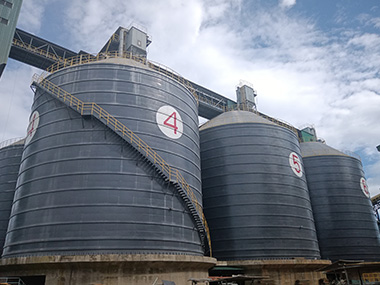

What Actually Drives Steel Silo Fabrication Costs (And What Doesn't)
Steel silo fabrication costs are driven by shell thickness, welding complexity, and surface preparation. A standard 3,000-tonne clinker silo costs between $120,000 and $180,000 to fabricate, but adding abrasion liners or meeting EN 1991-4 seismic codes can push that past $280,000. Material choice matters less than the labor to join it.
1. Material Specifications and Shell Thickness
Everyone asks about the price of steel plate. It's the wrong question. The real cost driver isn't the base metal price; it's the thickness and grade required to handle the specific bulk solid you're storing.
Why 6mm Isn't Always 6mm (Abrasion and Corrosion Allowances)
If you're storing heavy, abrasive materials like slag or coal, a standard 4mm shell won't survive five years. You need a corrosion and abrasion allowance. That usually means bumping the shell from 4mm to 6mm. Here's the math: a 2mm increase on a 10-meter diameter silo adds roughly 15% to the total steel weight. That's 15% more material, 15% more welding wire, and 15% more surface area to blast and paint. We typically specify ASTM A1011 or GB/T 700 Q235B for general cement, but switch to Q345B for high-density applications where yield strength matters more than simple tensile strength.
The Seismic Load Factor (EN 1991-4)
Seismic zones change everything. If you're building in a high-seismic area, EN 1991-4 dictates that your silo must resist lateral forces that a static silo never sees. I've seen projects in Turkey and Indonesia where the seismic load required ring stiffeners that doubled the structural steel weight. You're looking at 40% more anchor bolts—going from M30 to M48 grade—and a foundation that requires 30% more concrete. The silo shell might be 6mm, but the supporting structure becomes the cost driver.
2. Welding and Fabrication Complexity
Steel costs money. That's obvious. But the steel itself is rarely what kills your budget. It's the joining, the coating, and the bracing that bleed your contingency dry. Welding labor accounts for 35% to 45% of total fabrication costs.
Butt Welds vs. Fillet Welds (The Labor Trap)
Vertical seams on a silo shell require full penetration butt welds. You can't just lap them and run a fillet weld. We're talking about ASME Section VIII standards here. Every vertical seam needs back-gouging and grinding before the final cap pass. I watched a crew in Indonesia spend three weeks just grinding vertical seams on a 15,000-tonne silo because the fabricator skipped the back-gouging step. We found 40 lack-of-fusion defects in the first 10 meters. They spent $60,000 re-doing it. A single vertical butt weld takes a skilled welder 3 man-hours per meter. A fillet weld? 0.5 man-hours. The spec dictates the cost.
The Hidden Cost of NDT (Non-Destructive Testing)
You don't just weld it and hope. Non-destructive testing is mandatory for silos holding hazardous or high-value materials. ISO 5817 Level B acceptance criteria are standard. We perform 100% ultrasonic testing (UT) on vertical seams and 20% on horizontal seams. UT testing costs about $45 per meter. On a 20-meter tall silo with 8 vertical seams, that's $7,200 just for testing. Add radiographic testing (RT) for critical junctions, and you're paying $150 per shot. If the plant is in a remote area—like that copper mine we did in Zambia—mobilizing the NDT crew adds $15,000 to the budget before they even fire up the probe.
3. Surface Preparation and Coating Systems
Rust is a silo's cancer. If you skimp on surface prep, the coating fails, and the shell starts thinning from the inside out. Preparation and coating typically represent 20% of the total fabrication cost.
Grit Blasting to SA 2.5 (The Prep Work Nobody Budgets For)
You can't paint mill scale. The coating specification demands a near-white blast finish, ISO 8501-1 SA 2.5. That means the steel must be free from oil, grease, dirt, mill scale, rust, and paint. We use copper slag or aluminum oxide grit. Achieving SA 2.5 on structural steel runs about $25 per square meter. On a 5,000-square-meter silo, that's $125,000 just for blasting. And you've got a 6-hour window before flash rust forms in humid environments. I remember a project in Malaysia where the humidity hit 90%. The crew blasted at 4am, and by 9am, the steel was already spot-rusting. We had to re-blast 30% of the silo. The schedule slipped by four days.
Epoxy vs. Galvanizing (The 30-Year Math)
Hot-dip galvanizing (ISO 1461) costs $80 to $120 per square meter. A high-build epoxy system costs $35 to $50 per square meter. The knee-jerk reaction is to choose epoxy. Bad math. In a cement plant environment, epoxy coatings degrade under UV exposure and chalking. You'll re-coat every 12 years. Over a 40-year service life, three re-coating cycles will cost you $400,000. Galvanizing lasts 40 years with zero maintenance. The upfront cost is higher, but the total cost of ownership is 60% lower. We only specify epoxy when the chemical compatibility of zinc doesn't work—like in high-sulfur environments.
4. Geometrics and Site Constraints
A silo isn't a standalone piece of equipment. It has to fit on your site, and the ground has to hold it. The interaction between the silo geometry and the physical site creates massive cost swings.
Height-to-Diameter Ratio (Wind Loads and Eurocode)
Eurocode 1, Part 4 governs wind actions on silos. A squat silo—say, 15 meters in diameter and 15 meters tall—handles wind loads easily. But if you're constrained by a narrow footprint and need a 30-meter tall, 6-meter diameter silo, the wind loads become enormous. The shell thickness might be 6mm for storage, but the wind loads require 8mm at the top rings to prevent buckling. You also need helical stiffeners. Adding stiffeners increases the steel weight by 25%, but adds zero storage capacity. You're paying for steel that holds up other steel.
Tight Sites and Crane Access
Shop fabrication is always cheaper than field fabrication. In a shop, a crane costs $500 a day, and welders work in controlled conditions. In the field, you need a 200-tonne mobile crane just to lift shell courses. That crane costs $45,000 a day to mobilize and operate. If the site is tight—like that grain terminal expansion in Vietnam where we had 4 meters of clearance between the new silo and an existing conveyor gallery—the crane can't swing. We had to use hydraulic jacks to pull the shell courses up. It took three weeks instead of one. The client paid an extra $80,000 for the specialized jacking equipment. Always check the crane radius before you finalize the design.
5. Internal Components and Structural Steel
The shell is just the container. The internal components dictate whether the material actually flows out the bottom. Under-specifying internals is the fastest way to turn a $200,000 silo into a $50,000 concrete monument.
Aeration Floors and Cone Designs
Aeration floors aren't just perforated plates. They're engineered structures that must withstand the full bulk material weight while distributing air at 0.5 to 1.0 cubic meters per minute per square meter. We use 16mm thick steel plates with fluidization tiles. The cost runs $120 per square meter. If you're storing fly ash, you need a 60-degree cone angle to ensure mass flow. A 45-degree cone costs 20% less in steel, but if the fly ash bridges, you'll spend $50,000 on air cannons and vibrators to break the bridges. I'm not a fan of 45-degree cones for cohesive materials. They look cheaper on paper, but they're a operational nightmare.
Hopper Liners and Wear Plates
If you're storing abrasive materials like limestone or coal, the cone bottom will wear through in 18 months without liners. We use 10mm thick cast basalt liners or 16Mn wear plates. Cast basalt costs $180 per square meter and lasts 10 years. A standard 16Mn steel liner costs $60 per square meter but wears out in 2 years. The math is simple: replacing a liner requires a full silo shutdown, scaffolding, and 3 weeks of labor. That downtime costs $10,000 a day. Spend the money on basalt upfront.
Case Study: The 5,000-Tonne Fly Ash Silo in Shandong
A client came to us with a quote from a local fabricator for a 5,000-tonne fly ash silo. The quote was $140,000. It looked great. But the spec called for 4mm shell thickness, SA 1.5 surface prep, and a 45-degree cone. We rejected the spec. Fly ash is highly abrasive and cohesive. We redesigned it with a 6mm shell, SA 2.5 blasting, and a 60-degree cone with cast basalt liners. Our price was $210,000. The client went with the cheaper option. Eighteen months later, the cone bottom wore through, and the fly ash bridged solid. The plant lost $350,000 in downtime and emergency repairs. The $70,000 they saved upfront cost them five times that in year two.
FAQ
Does steel price volatility significantly delay fabrication?
Yes. A 15% spike in hot-rolled coil prices adds 8% to the total project cost. We lock steel prices at contract signing. If the client delays the signature by 30 days, we re-quote. I've seen projects in Brazil where the steel price jumped $120 per tonne in a month. That's a $40,000 surprise on a mid-sized silo.
Can I use thinner steel for dry, non-abrasive materials like alumina?
Yes, but EN 1993-4-1 sets a minimum thickness for shell stability at 4mm. Going thinner than 4mm causes shell buckling under wind loads, regardless of material abrasiveness. You can use 4mm for alumina, but you still need the corrosion allowance if the plant is in a coastal area. Salt air will eat 0.5mm of steel per year.
What's the biggest fabrication cost mistake you see?
Under-specifying the cone angle. A 45-degree cone costs 20% less in steel than a 60-degree cone, but if your material needs a 60-degree flow, you'll spend $50,000 on air cannons and vibrators to fix the rat-holes. The steel is cheap. The operational headaches are expensive.
Stop Guessing on Silo Costs
You don't need a cheaper silo. You need a silo that works. At Manxing, we've delivered EPC silo projects across 30+ countries, handling everything from cement to slag. We don't just fabricate steel—we engineer storage solutions that account for seismic loads, abrasion, and flow dynamics. Get a fabrication quote that actually reflects the operational reality of your plant.